Links to Allergena Shopping Cart Website

Showing posts with label pollen allergies. Show all posts

Tuesday, August 11, 2015

Honey and Pollen Allergies

Does Honey really help alleviate pollen allergies?


baking with honey

It sounds like a win/win situation.  Sweeten your teas and muffins with honey and cure your pollen allergies at the same time but the truth of the matter is honey probably does nothing to alleviate those itchy eyes and runny nose.
 
Still the idea isn't so far-fetched. Some experts point out that honey can contain traces of flower pollen — an allergen and one treatment for allergies is repeated exposure to small amounts of allergens.

In recent years, scientists have discovered that honey possesses some legitimately intriguing properties. Proteins secreted by honeybees, for instance, are mixed with the flower nectar bees use to produce honey, and science has recently discovered that one of these proteins, called “bee defensin-1” has significant antibacterial, anti fungal, and antiviral properties.

The misconception comes from the pollen the bees mostly carry back to the hive.  In the previous post we talked about insect pollinated vs. wind-pollinated? The pollen blowing in the wind (released by non-flowering trees, weeds, and grasses) is what triggers springtime allergies not the pollen in flowers carried by bees. So even local honey won’t have much, if any, of the type of pollen setting off your allergies.

Studies also show that bees don’t just bring flower pollen back to their honeycomb. They carry tree and grass pollen, in addition to mold spores, diesel particles, and other contaminants. Which means that it’s difficult to make a honey from just one kind of pollen (say, weeds and not grass). So, save your local honey for your tea and muffins, not for your allergy medicine cabinet.

If you want help from pollen allergies you need to try a product that consists of what a person is allergic to so the body becomes safely conditioned to tolerate those allergens and reduce allergic symptoms.


Tuesday, August 4, 2015

Pollen Allergies


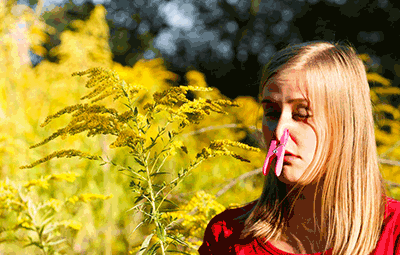
Pollen allergies or as it is better known, Hay Fever, are directly related to things in our environment.


Lady with a close pin on her nose to keep out the pollen

Did you know Hay fever has nothing to do with hay?  It got its name because long ago farmers noticed that their symptoms of runny noses and itchy eyes occurred during the season of the spring hay harvest, and so they connected it with hay. When actually the watery eyes and sinus headaches are most often due to pollen from the beautiful plants and trees adorning your yard or neighborhood.

The best way to battle pollen allergies is to find out which pollens you are allergic to. An allergist is able to easily test you for various types of trees, weeds, and grasses, and provide you with a list of pollens that negatively affect your body.

Below are a few types of plants that are known to cause pollen allergies:

Trees:  Birch, Alder, Cedar, Hazelnut, Willow, Plane, Olive and Hornbeam Grasses:  Ryegrass &amp Timothy Weeds:  Ragweed, Nettle, Mugwort, Goosefoot abd Sorrel.

Depending on where you live, your individual sensitivity may differ dramatically. If a person lives in an area that has hot, dry, windy days, then there is more of a chance that pollen is in the air. Whereas if you live in areas where the air is cool or there are more rainy days, the pollen is washed to the ground and is less likely to affect you.

Tune into your local weather channel or get online to find out the days pollen count.  Allergy pollen counts allow you to see how you could be affected right in your own hometown. On days when the count is high you don’t have to suffer from pollen allergies or hay fever, which has nothing to do with hay.